80 PLUS Titanium Efficiency Engineering
Titanium is not a certificate you print — it is a loss budget you design to. The 230V internal redundant gate demands at least 90% efficiency at 10% load, 96% at 50% and 91% at 100%. Our production CRPS platforms from 550W to 2400W are engineered against exactly that curve, because 50% load is where a redundant fleet actually lives: an N+1 pair of 1300W units backing a 1300W draw sits at half load all day, every day.
The Titanium Gate, Point by Point
The 80 PLUS program defines Titanium for 230V internal redundant supplies at three load points. This is the tier data-center buyers treat as the de facto procurement threshold — Gold at 92% @ 50% no longer clears hyperscale TCO reviews.
| Load point | Titanium requirement (230V redundant) | Design focus at TitanWatt |
|---|---|---|
| 10% | ≥ 90% | Burst-mode control and low gate-drive losses keep light-load nights efficient |
| 50% | ≥ 96% | Zero-voltage LLC switching plus synchronous rectification — the headline point |
| 100% | ≥ 91% | Conduction-loss control in magnetics and MOSFET RDS(on) selection |
| PF @ 50% | ≥ 0.95 | DC-PFC front end shaped for power factor, not just harmonic compliance |
Efficiency Across the Load Curve
Simplified representation of the Titanium redundant curve on our production platforms: the three certified load points and the shape between them.
The Topology Doing the Work
Two conversion stages decide whether a supply clears Titanium or stops at Platinum. Our platforms use industry-standard high-efficiency building blocks, tuned per wattage segment:
DC-PFC front end. The input stage rectifies and boosts with a topology chosen for low switching loss across the universal AC range, holding power factor at 0.95 or better at 50% load and keeping 200Vac full-load operation stable on C13/C14 or C19/C20 inlets.
LLC resonant stage with synchronous rectification. The isolated stage switches at zero voltage, which removes most turn-on loss, and rectifier diodes are replaced with MOSFETs driven as synchronous rectifiers — the single biggest contributor to the 96% mid-load point. At 10% load, burst-mode operation trades ripple for standby-class losses, holding the curve above the 90% gate.
The Money Between Gold and Titanium
The four-point efficiency gap at mid-load sounds abstract until it is multiplied by rack count and runtime.
And every watt saved as heat is a watt the cooling system does not have to move: at rack densities of 40–120kW, efficiency compounds twice — once on the power bill, once on the airflow budget.
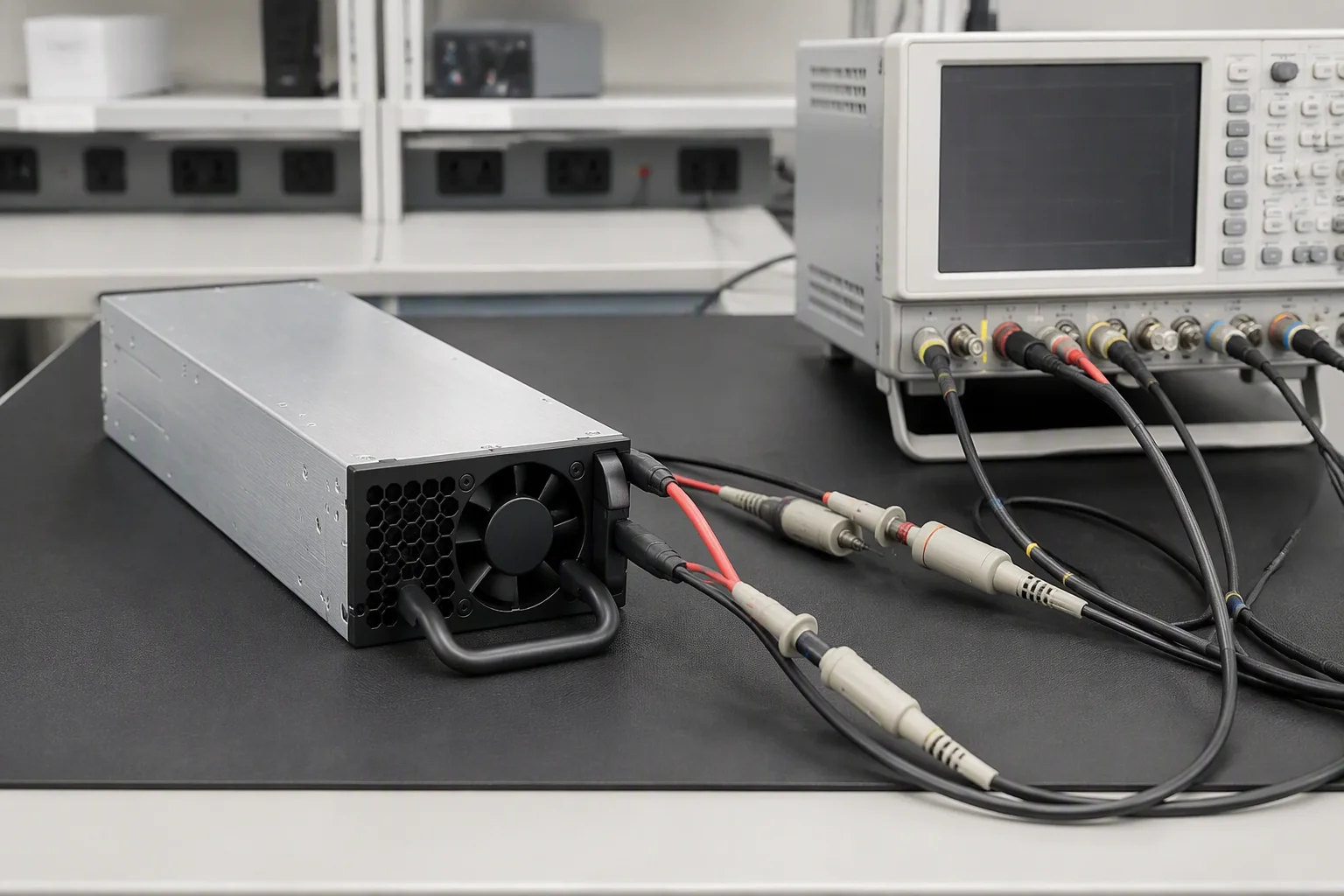
Every Efficiency Point Is Bench-Verified
Titanium is won at three load points, not in a marketing table. We verify 90% at 10%, 96% at 50% and 91% at 100% on calibrated analyzers before a design freezes — and re-verify on production samples, so the curve on the datasheet is the curve in your rack.
Efficiency Engineering FAQ

Put the Titanium Curve to Work in Your Rack
Send your load profile — we will return the expected efficiency at your actual operating point, with test data from matching production units.