Open-Spec Power for Hyperscale ODM Programs
When a hyperscaler designs its own servers and buys through ODM Direct, the power supply stops being a black box ordered with the chassis. It becomes a component negotiated on its own terms: open mechanical specs like ORv3, efficiency scrutinized to the decimal, and a supply chain that must deliver fifty thousand units that behave identically. We are built for that procurement model — an ODM with SMT+DIP lines, ATE and burn-in in-house, speaking fluent ORv3.
What ODM Direct Buyers Actually Fight Over
Closed specs lock in vendors
Proprietary power form factors make every shelf a single-source decision. ORv3 breaks that: a 33kW shelf is defined as 6×5.5kW modules in a 5+1 arrangement on a shared slot, so any qualified vendor can compete module by module — and you can dual-source without redesigning the rack.
One efficiency point is real money
Moving distribution to a 54V busbar cuts current by a factor of four, and because resistive loss scales with the square, cable and busbar loss drops roughly sixteenfold. At hyperscale fleet sizes, a single efficiency percentage is measured in millions of kilowatt-hours per year — which is why Titanium's 96% peak is a negotiating position, not a badge.
Batch drift breaks fleet software
Fleet-level power capping and thermal control assume every PSU reports and behaves the same. If week 3 of production ships with a different fan curve or PMBus response than week 40, your automation chases ghosts. Consistency is a manufacturing-system property, not a datasheet property.
Metrics That Decide the Award

An ODM Supplier Structured for Open Specs
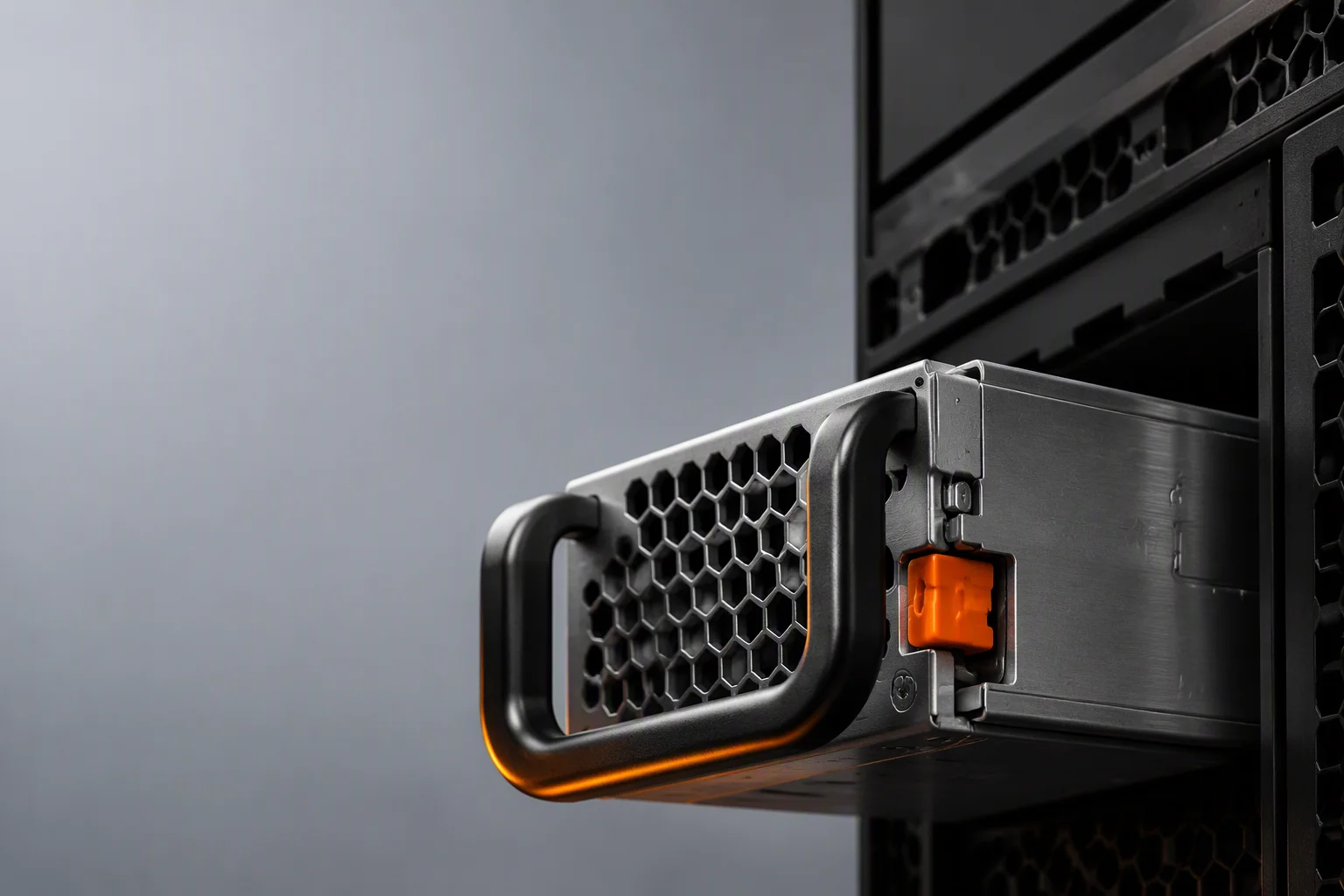
Our M-CRPS program targets the ORv3 slot directly: 3000W, 3300W and 5500W modules with modular power and output sections, 54V output, and protection and telemetry behavior defined in the open so your shelf firmware and ours agree by specification, not by reverse engineering. These units ship today as development samples for joint evaluation — with published target specs and a declared path to volume, never dressed up as production stock.
Consistency comes from the line, and the line is ours: SMT+DIP placement, automated ATE screening of every unit's efficiency and protection trip points, and a burn-in aging room that runs finished goods under load before packing. Configuration and test records stay traceable per serial, so batch 1 and batch 50 can be audited against each other. That is the same EMS manufacturing discipline hyperscale ODMs apply to their own builds, applied to your power.
Program Fit by Stage
| Program Need | Recommended Part | Why It Fits | Status |
|---|---|---|---|
| 12V legacy racks still in fleet | CRPS 550W–1300W / 1600W–2400W | Standard envelope, dual-sourceable, fleet-consistent telemetry | In production |
| ORv3 slot qualification | M-CRPS 3000W–5500W | Modular sections, 54V, open target spec for joint dev | Development Samples |
| Shelf-level integration | Power Shelf 33kW | 6×5.5kW on one 54V busbar, 5+1 hot-swap | Roadmap |
Standard orders start at 100–500 pcs; samples in 2–4 weeks, volume in 6–10 weeks including burn-in. MOQ for hyperscale programs is negotiated per project.

Dual-Source Your 54V Program
Share your ORv3 slot checklist and consistency requirements — we will return a qualification plan and sample schedule within 48 hours.