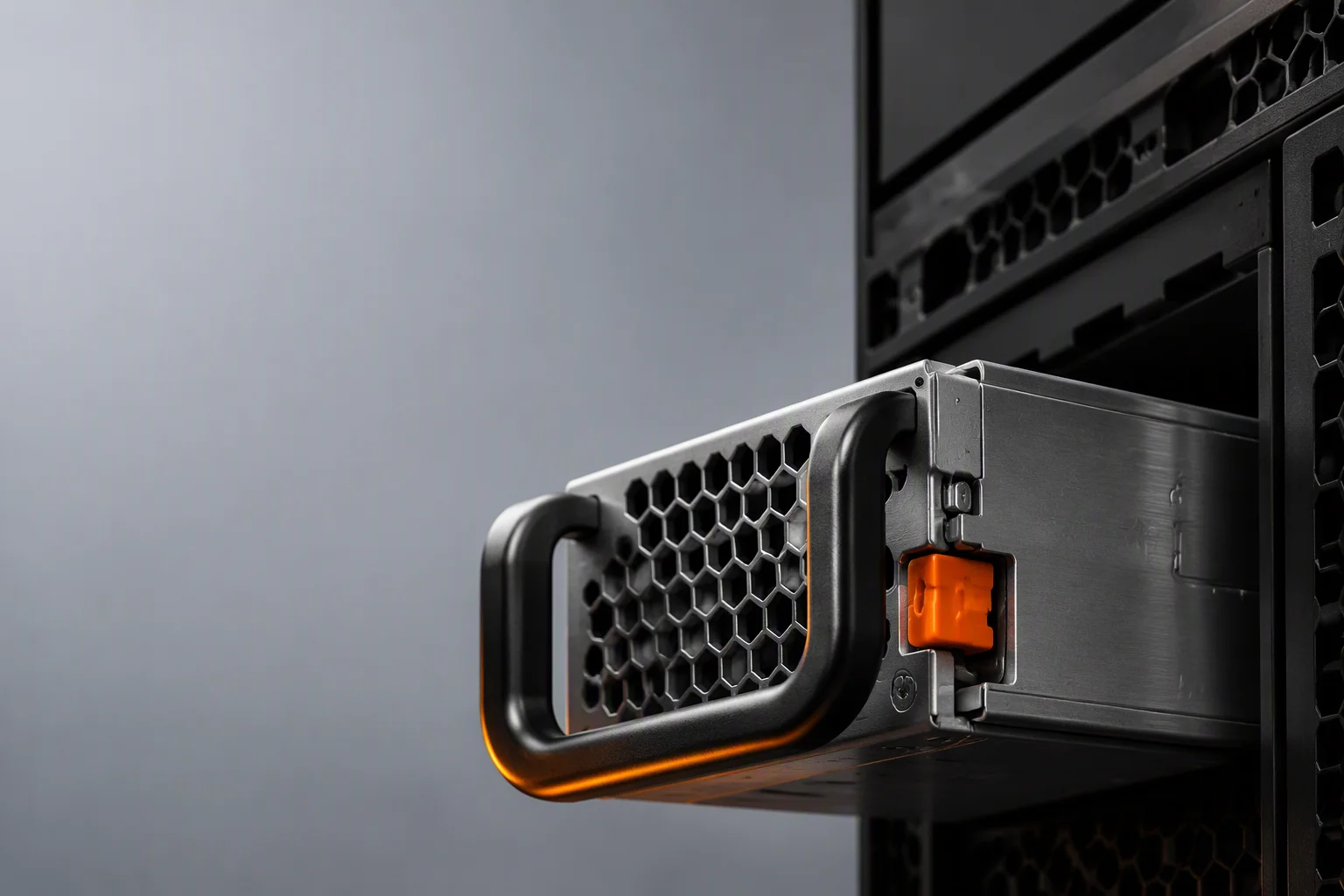
Power for JBOD, SAN & Object Storage
A storage array is the one machine in the data center that never gets to rest. Disks spin and flash writes land around the clock, backfill and rebuild jobs push the power envelope on purpose, and the array's whole reason for existing is that nothing in it ever disappears. That duty profile — 7×24, at or near full load, for years — is a different endurance test than a compute node ever sees, and it shapes every choice in a storage power design.
Why Storage Power Is Not Server Power
7×24 at full write load
Compute nodes idle; storage does not. Rebuild storms and cache flushes can push an enclosure to its rated draw for hours at a time, at all hours. Components must be stressed and screened for continuous high-load operation — our burn-in room runs finished units under real load precisely so week one in the rack is not the first time the supply works that hard.
Two power paths, zero ambiguity
Storage enclosures feed dual controllers on separate power paths, often from separate PDUs. The PSU must respect path isolation cleanly, hand its full share to its twin without a reset when one path drops, and recover gracefully when the path returns. Sloppy path behavior corrupts more than performance graphs.
Sharing the load unevenly is failure
In an N+1 pair or trio, supplies that drift apart in output regulation force one unit to run hot while its neighbor coasts — aging the fleet at different rates until the hot one trips. Active current sharing keeps every module in an array carrying its proportional slice, at 800W through 2kW outputs alike.
Four Requirements That Matter Here
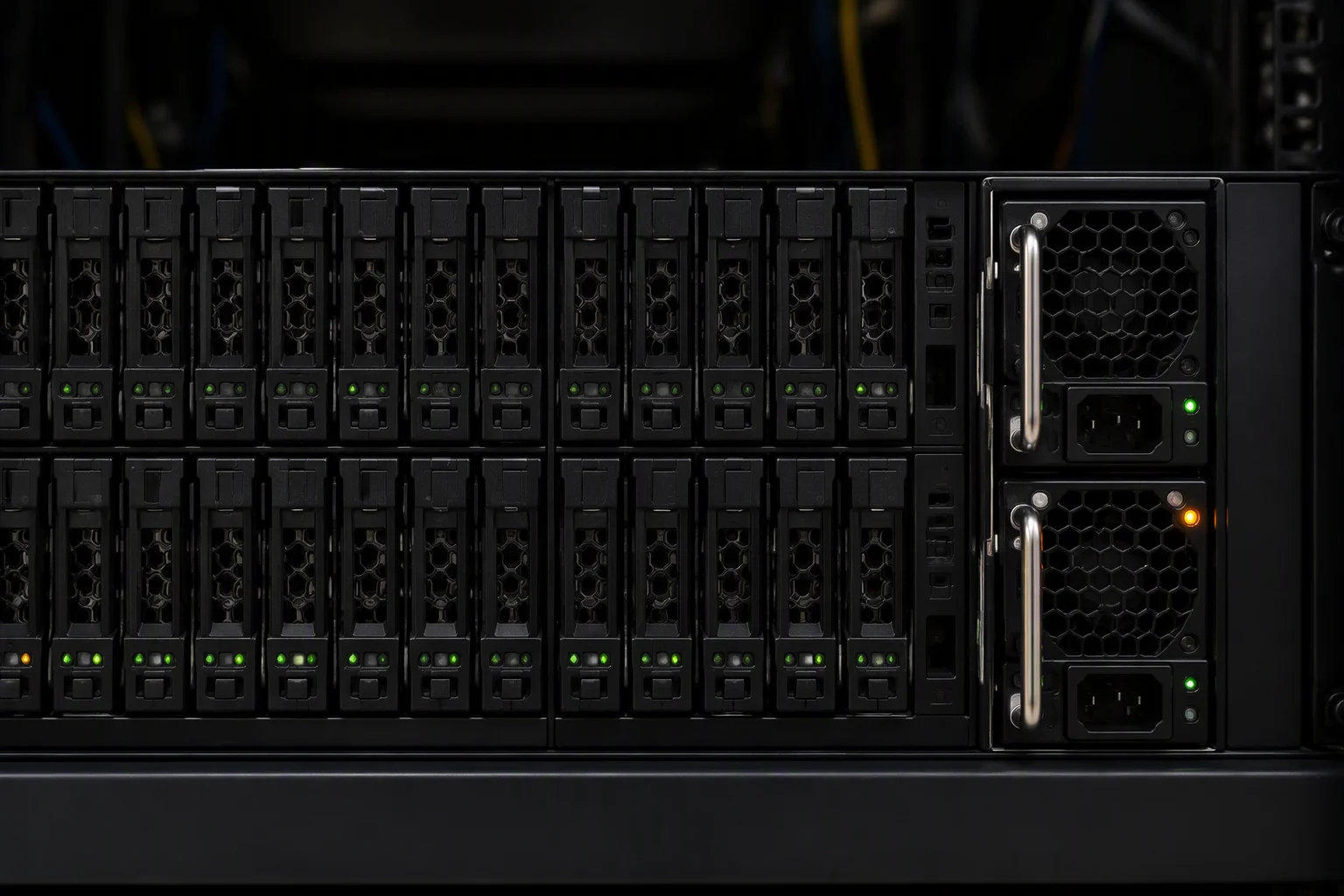
Titanium CRPS from 800W to 2kW, Sharing Evenly
Our 800W and 1300W units cover mid-density JBOD and unified arrays; the 1600W, 2000W and 2400W band covers high-density enclosures with C19 input at 200Vac. All are Titanium-class, converting at 96% peak and 90% even at 10% load — relevant because an array that idles between write bursts should not pay Gold-class losses during the quiet hours.
Redundancy is designed the way storage expects it: hot-pluggable N+1 with active current sharing across the module set, clean behavior on single-path loss, and the full five protections (OVP/UVP/OCP/OTP, fan-fail) so a fault announces itself before it propagates. On smart variants, PMBus 1.2 over I²C exposes per-module current and temperature so your enclosure firmware can forecast headroom before a rebuild job starts. Units are screened on ATE and loaded in the burn-in room before shipment; every order of 100–500 pcs ships with consistency you can audit by serial number.
Match Supply to Enclosure Class
| Enclosure | Recommended Part | Configuration | Status |
|---|---|---|---|
| 2U/4U JBOD, disk-dual-domain | CRPS 800W / 1300W | 1+1 A/B feeds, current sharing | In production |
| High-density JBOD / object storage | CRPS 1600W-2400W | N+1, C19 input, PMBus variant | In production |
| All-flash scale-out nodes | CRPS 2000W / 2400W | N+1 with telemetry-driven headroom | In production |
Samples in 2–4 weeks; volume in 6–10 weeks including loaded burn-in. Airflow direction can be matched front-to-back or back-to-front per enclosure design.
Designing a Dual-Path Enclosure?
Send us your enclosure power profile and A/B feed diagram — we will recommend a wattage tier and PMBus option within 48 hours.