Power Supplies for AI Training & Inference Clusters
An H100 SXM draws 700W. A B200 draws 1000W. Multiply by eight GPUs, add CPUs, NICs, NVMe and fans, and a single HGX node crosses 10kW of system load — then stack those nodes into racks that reach 40-120kW. That jump broke the old 12V power hierarchy, and it is why AI clusters are moving to high-wattage M-CRPS modules on a 54V bus. We build for exactly that trajectory.
Why AI Rack Power Is a Different Discipline
GPU wattage doubled in three years
700W per H100 became 1000W per B200, and the card-level 12VHPWR connector tops out at 600W. A power plan written for the previous generation of accelerators is already obsolete before the rack is installed.
Rack density grew 10x
Conventional racks drew 5-10kW. AI racks now span 40-120kW. At those currents, 12V distribution waste becomes thermal load you must pay to remove twice — once electrically, once in cooling.
Every failure is a cluster event
Uptime Institute puts the cost of data center downtime near $9,000 per hour. In an N+1 shelf the surviving modules must carry full load without droop, which demands active current sharing and honest derating data — not optimistic datasheets.
Four Numbers That Define the Spec
M-CRPS at 3-5.5kW, on a 54V Bus
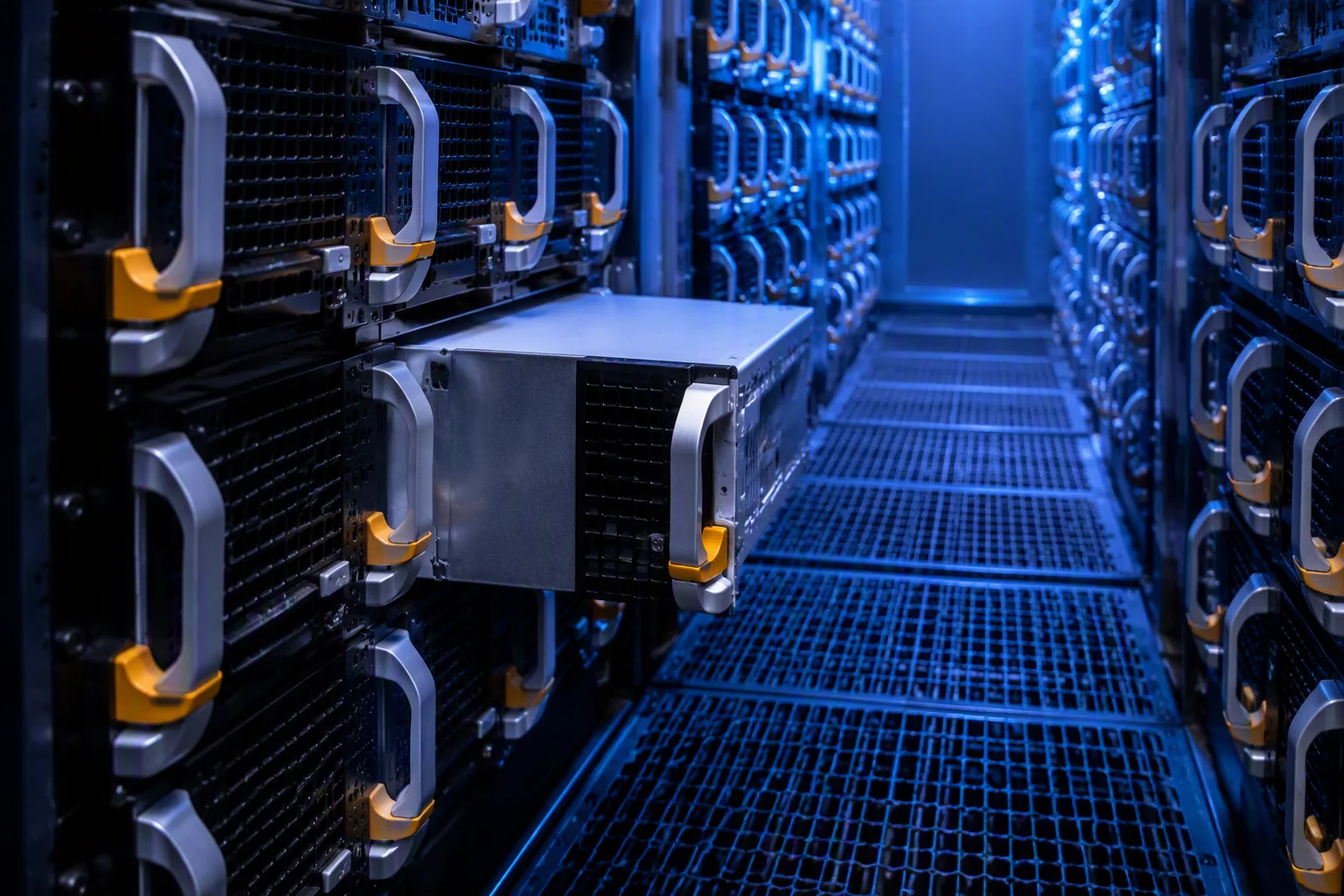
The physics are simple: at rack scale, a 54V distribution path moves the same power through a fraction of the copper, and heat in the busbar stops being the design bottleneck. Our M-CRPS modules in the 3000W, 3300W and 5500W class place modular power and output sections into ORv3-style slots, so a 33kW shelf becomes six 5.5kW units in a 5+1 arrangement.
Every module carries the five protections (OVP/UVP/OCP/OTP, fan-fail) plus PMBus 1.2 telemetry over I²C, so your BMC sees per-module voltage, current, temperature and fan speed. Titanium-class conversion at 96% peak keeps more of every kilowatt bought from the utility on the bus instead of in the hot aisle. These 54V segments are supplied as development samples for joint evaluation with lead customers — target specs are published openly, and we do not label them production before they are.
Matching the Tier to the Node
| Deployment | Recommended Part | Architecture | Status |
|---|---|---|---|
| 8-GPU H100 node, CPU/NIC/NVMe included | CRPS 1600W–2400W | 4-6× PSU, N+1, 12V, PMBus fleet polling | In production |
| B200-class node or 54V-ready rack | M-CRPS 3000W–5500W | Shelf + 54V busbar, 5+1 modules, active current sharing | Development Samples |
| Full 33kW rack power system | Power Shelf 33kW | 6×5.5kW, cold-redundancy option, shelf-level telemetry | Roadmap |
Samples ship in 2–4 weeks; volume production runs 6–10 weeks including burn-in. Development-stage 54V parts are scoped per project with lead customers.
Building a 54V Rack?
Send us your node power budget and shelf slot spec — we will map it to a module tier and share target datasheets for the 54V program within 48 hours.