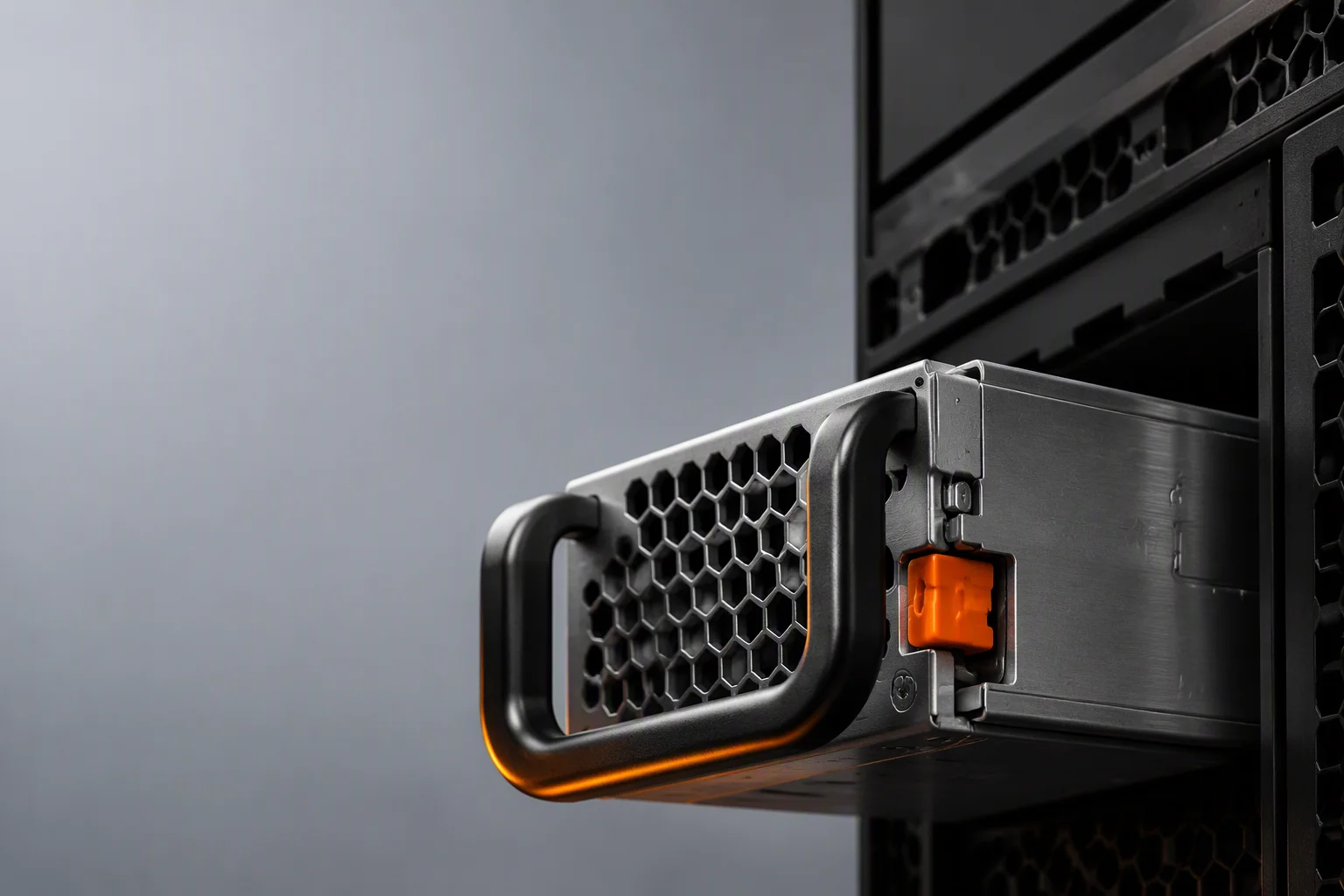
33kW Power Shelf: The Next Rung of the Rack
Status up front: the power shelf is on TitanWatt's roadmap — an architecture we are building toward with lead partners, not a product with a promised date. The industry has already shown the shape of it: Delta's ORv3 line pairs 3kW and 5.5kW PSUs with 18kW and 33kW power systems, and a 33kW shelf is simply six 5.5kW hot-plug modules in a 5+1 array behind one 54V busbar. This page explains that architecture honestly, including where we stand on it.
Anatomy of a 33kW Shelf
| Element | Architecture Role |
|---|---|
| Module count | 6 slots, 5.5kW hot-plug PSU per slot (33kW aggregate) |
| Redundancy | 5+1 — any single module can fail or be pulled with zero load interruption; 6+0 for max capacity |
| Busbar | 54V DC distribution to rack; 4× lower current, ~16× lower line loss than 12V |
| Shelf controller | Slot addressing, hot-plug sequencing, PMBus aggregation, throttle signaling to hosts |
| Input | Per-module C20 inlets at 200–240Vac from rack PDUs; dual power domains supported |
| Rack arithmetic | 4×33kW shelves service a ~120kW GB200 NVL72-class AI rack |
| Serviceability | Front-access hot swap; module MTBF target ≥ 250k hrs @ 40°C per module |
| TitanWatt status | Roadmap — module foundation in development samples, shelf defined jointly with partners |
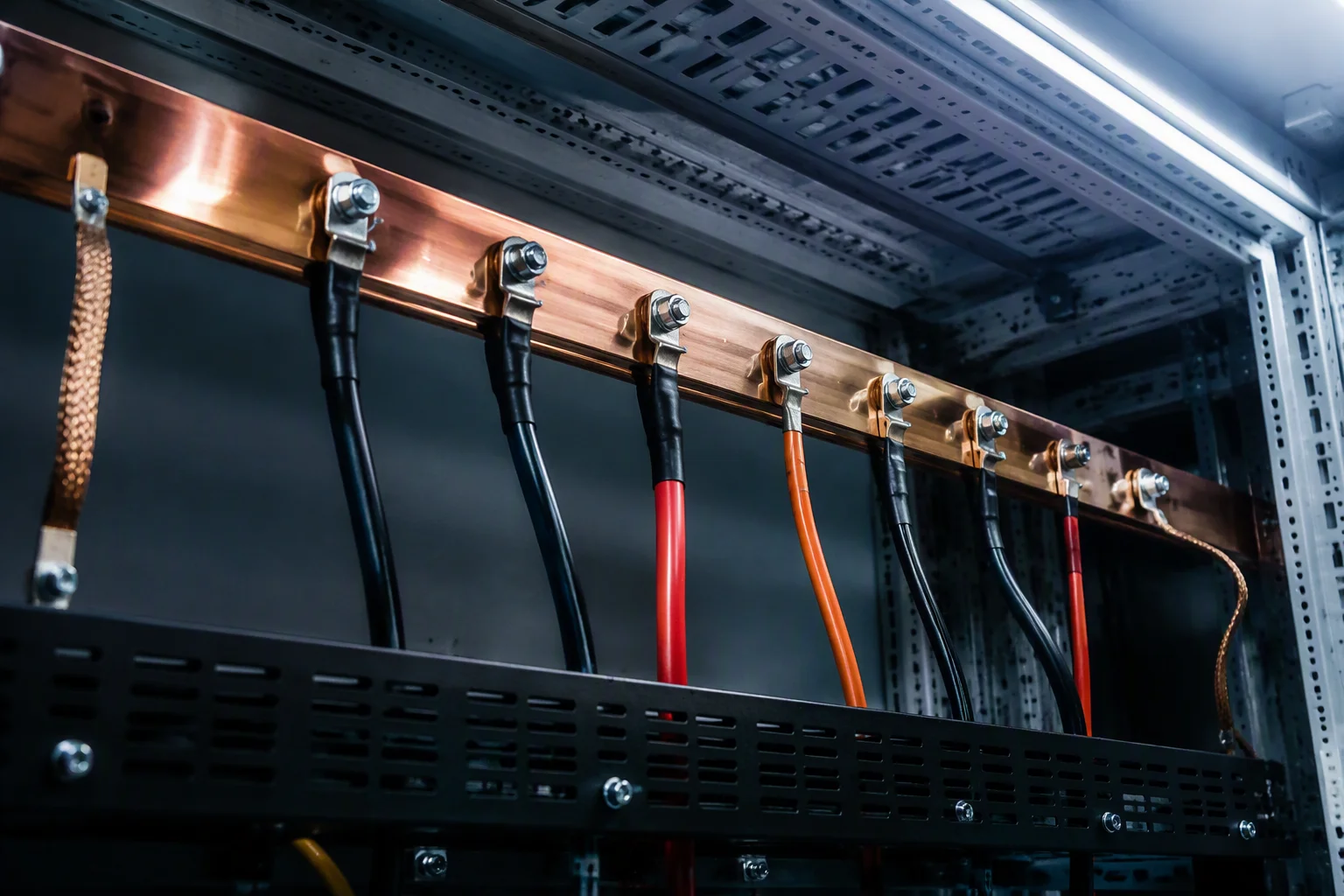
Why the Busbar Is 54V
Current drops 4×
At 54V instead of 12V, the same power moves through one quarter of the current. That shrinks busbar cross-section, connector contact ratings and PCB copper weights across the whole distribution path.
Line loss drops ~16×
Resistive loss scales with the square of current (I²R), so a quarter of the current means roughly a sixteenth of the heat. At rack powers of 40–120kW, that is the difference between distribution you can cool and distribution that cooks the rack.
This is the same physics that pushed telecom plants to −48V decades ago; the ORv3 ecosystem is its data-center edition. The 54V conversion happens on-board at each GPU node, where modern VRM stages handle it efficiently — the shelf's job is to deliver clean, metered, redundant 54V.
The Ladder the Industry Is Climbing
The established pattern runs: PSU module → power shelf → rack-level power system. Delta's ORv3 catalog makes the ladder explicit — 3kW and 5.5kW PSUs at the bottom, 18kW and 33kW systems at the top, six slots per shelf, 5+1 redundancy. AI racks at 40–120kW make shelf-level 54V less an innovation than an inevitability.
TitanWatt's position on this ladder is deliberate: we master each rung before claiming the next. The 550W–2400W CRPS series is in production; the 3000W–5500W M-CRPS modules are development samples; the shelf is roadmap. We publish this progression rather than promising dates we would then have to move.
Our Modules Are the Shelf's Building Blocks
A power shelf is only as good as its modules, and a 5.5kW module is not a scaled-up 2.4kW brick — it is the M-CRPS architecture: separable power and output sections, ORv3-slot targeting, 54V primary output, PMBus 1.2 telemetry that the shelf controller aggregates. Every hour our engineering team spends validating the 5.5kW M-CRPS development samples is direct progress toward the shelf, which is why the two programs share one roadmap and one partner group. Customers who join the module program today inherit the shelf option tomorrow without a second qualification campaign.
Who We Build the Shelf With
ODM Direct / hyperscale teams
If your rack roadmap already includes ORv3-class shelves, co-defining the module spec with us now means your shelf architecture and PSU qualification advance together — one spec freeze, one EVT loop.
Rack integrators
Integrators assembling AI rack solutions need a module partner who will be honest about maturity. We bring production discipline from the CRPS lines and a development program with visible gates — no vaporware in your BOM.
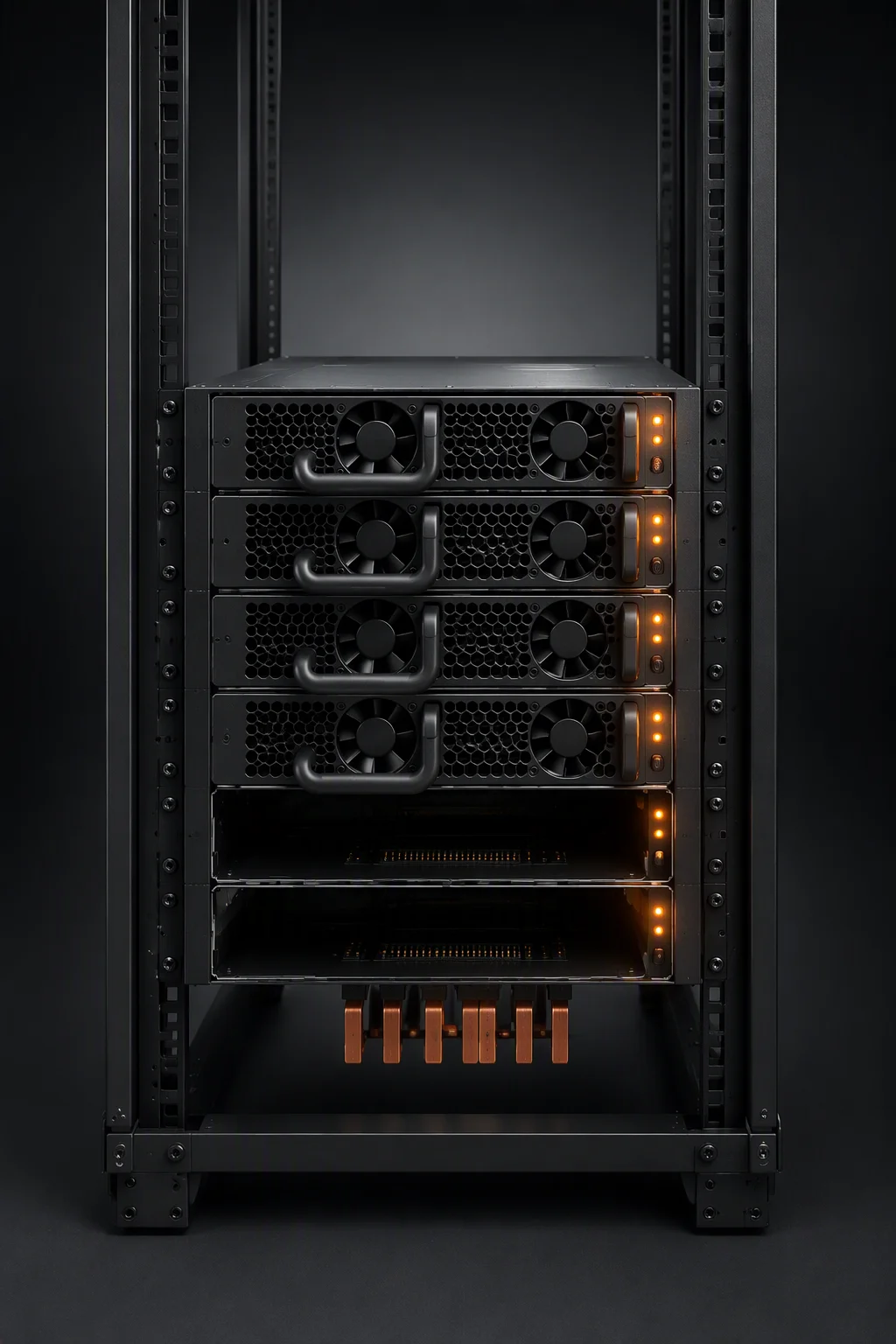
Six Slots, One 33kW Frame
A power shelf is mechanically simple — six horizontal slots, a shared fan wall, copper busbar fingers below — but every watt of the 33kW frame crosses those interfaces. That is why our roadmap starts from the module: a proven 5.5kW unit first, the shelf around it second.
FAQ

Define the Shelf With Us
Hyperscale and rack-integrator partners: bring your rack power roadmap, we bring the module foundation. Reply within 48 hours.