Quality as a System, Not a Slogan
A power supply is the one component in a server whose failure takes the whole machine down, which is why quality failures here are never cheap. The TitanWatt quality system is therefore built around one idea: nothing ships on faith. An ISO 9001-governed quality management system, a three-stage inspection chain from incoming parts to outgoing pallet, an in-house safety laboratory, and unit-level traceability make the 250,000-hour MTBF target on our datasheets an engineered outcome rather than a hope.
An In-House Laboratory, Not a Rented One
Our on-site laboratory performs the routine safety verification that certification regimes require per production lot: hi-pot dielectric strength, protective-earth bonding and touch-current (leakage) testing. It also runs pre-compliance EMC pre-scans, so a layout change or a new component lot that pushes emissions toward the CISPR 32 Class A limit is caught on our bench — not in an external lab three weeks into a re-certification.
Because the lab sits on the production floor, the loop between a test result and a process correction is measured in hours. The same lab supports design-stage verification for new platforms — for example the M-CRPS development units now in joint evaluation — so dev-stage data and production-stage data live in one system.
Three Checks: Incoming, In-Process, Outgoing
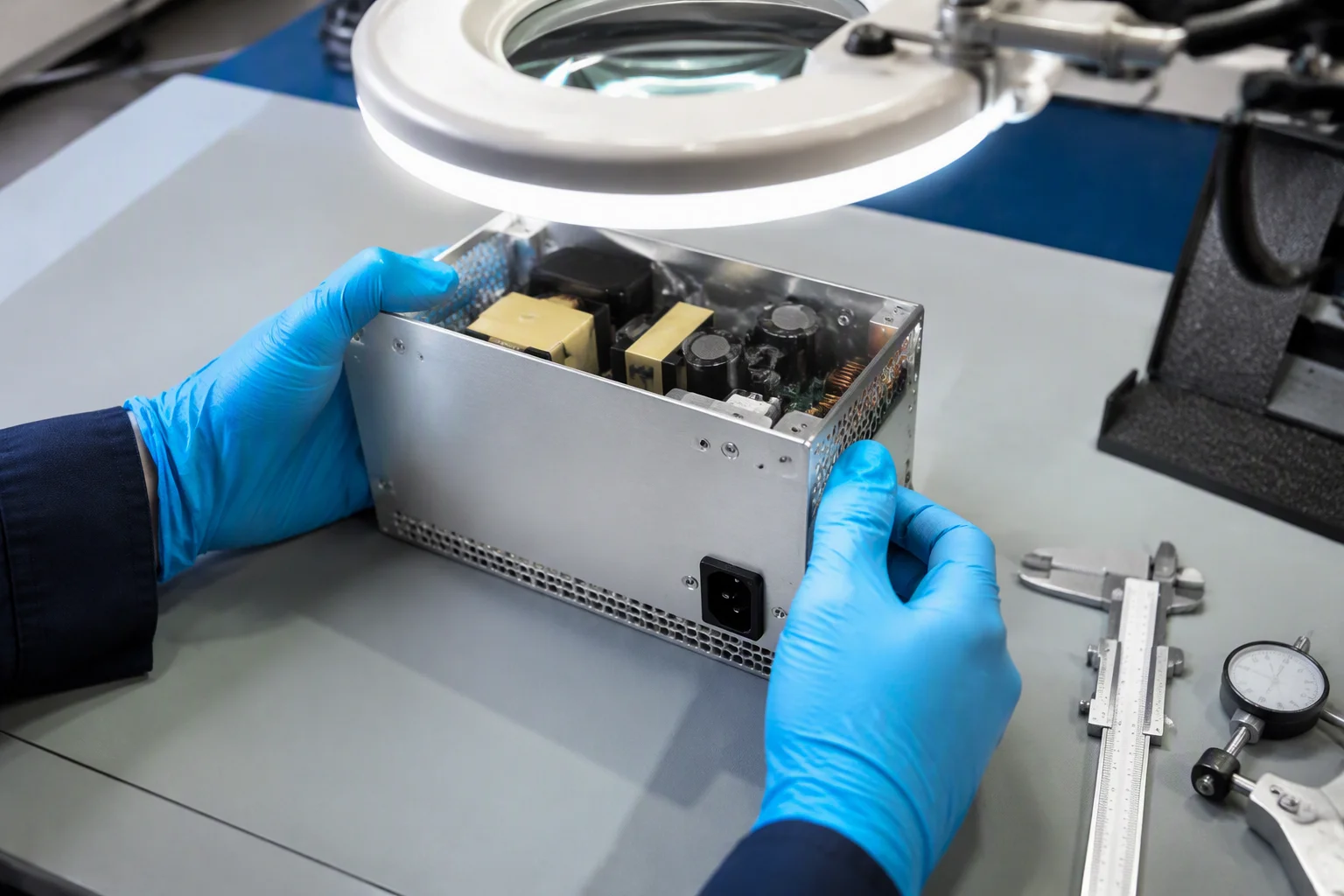
Every critical component lot — power semiconductors, electrolytic capacitors, magnetics, fans, connectors — is sampled against an AQL plan and a per-part qualification file before it enters the warehouse. Fan lots are run-checked for noise and speed; capacitor lots verify brand, date code and ESR sampling. Nonconforming lots are quarantined and fed back to the supplier with data.
On the SMT+DIP lines, solder-paste inspection precedes reflow and AOI follows placement; the power stage gets verified joints on through-hole devices and correct torque on heatsink assemblies. Line-side checks confirm the golden-finger dimensions and mechanical fit of the 73.5×40×185mm CRPS envelope, and protection trip points (OVP/UVP/OCP/OTP/fan-fault) are verified at ATE on every unit — not on a sample.
Before packing, each unit has passed the full burn-in aging cycle with monitoring and a post-aging ATE re-test. OQC audits finished cartons against the order: serial-number continuity, label and rating accuracy, PMBus firmware version, accessory and documentation content. Only lots with a complete traceability record are released for shipment.
Certification Matrix
We state certifications by name and scope. Certificate documents and reports are provided to customers under NDA; we do not publish certificate numbers on public pages. Regional certifications beyond this matrix (for example CCC, KC, BSMI) are handled per target market on a project basis.
| Certification / Standard | Category | Scope on TitanWatt Platforms |
|---|---|---|
| IEC/UL/EN 62368-1 | Safety | Hazard-based product safety for all CRPS and M-CRPS units; supersedes the retired 60950-1 |
| CB Scheme | Safety | Mutual-recognition report enabling national certifications from a single test file |
| CE | EU conformity | LVD and EMC directives for shipment into EU markets |
| UKCA | UK conformity | UK market marking for safety and EMC |
| FCC Part 15 Subpart B | EMC | Conducted and radiated emissions, Class A (equipment-grade) limits |
| RoHS 2.0 | Environmental | Restriction of hazardous substances across the bill of materials |
| REACH | Environmental | SVHC screening and declaration for EU chemical compliance |
| ISO 9001 | Quality system | Factory quality management system governing IQC, IPQC and OQC |
What the Platform Carries
IEC/UL 62368-1
Hazard-based safety standard for all shipped units.
CB Scheme
One report, many national certifications.
CE
LVD + EMC conformity for EU shipment.
UKCA
UK market marking for safety and EMC.
FCC Part 15 B
Class A conducted and radiated emissions.
RoHS 2.0
Hazardous-substance restrictions across the BOM.
REACH
SVHC screening and EU chemical declarations.
ISO 9001
Quality management system behind every shipment.
Every Serial Number Tells Its Own Story
Traceability ties the chain together. A unit's serial number links to its component lot records (so a field event can be scoped to exact capacitor or fan date codes), its ATE test record at every gate including the post-burn-in re-test, its aging-room batch data, and its OQC release record. When a customer requests a burn-in report or a shipment quality summary, we generate it from the same system that built the unit — not from a template.
The reliability numbers this system supports are the ones we publish: a 250,000-hour MTBF design target at 40°C per Telcordia SR-332, continuous full output from -5°C to +55°C ambient, and PMBus 1.2 telemetry that lets your own fleet monitoring see degradation before it becomes a failure.