CRPS Sourcing, Answered Plainly
Minimum quantities, lead times, trade terms, certifications and customization — the questions OEM and ODM buyers ask most before specifying a titanium-class CRPS power supply.
From Inquiry to Production in Six Steps
You share target wattage, form factor, output architecture and annual volume through the contact form or email.
Our engineers review the specification against the CRPS-185 envelope, airflow and efficiency targets, and flag any gaps.
You receive pricing by quantity break, tooling or NRE if applicable, and trade terms — FOB Shenzhen as standard.
Engineering samples are built on the SMT+DIP line, ATE-tested and shipped for your chassis integration and burn-in.
Compatibility, hot-swap sequencing, PMBus telemetry and thermal behavior are validated in your system before design freeze.
Mass production runs with 100% ATE test plus burn-in screening; test and aging reports accompany each shipment.
Twelve Questions Buyers Ask First
Standard catalog models start at 100 to 500 pieces per order, depending on the wattage segment — lower for the 550W–1300W workhorse range, higher for the 1600W–2400W high-density units. ODM customization projects are quoted per project with no fixed MOQ.
Engineering samples take 2–4 weeks from spec freeze. Mass production after design approval takes 6–10 weeks, including burn-in screening and final ATE test on every unit.
FOB Shenzhen (Yantian) is our standard term. CIF and DDP can be negotiated for volume orders and repeat customers — tell us your preferred incoterm in the inquiry.
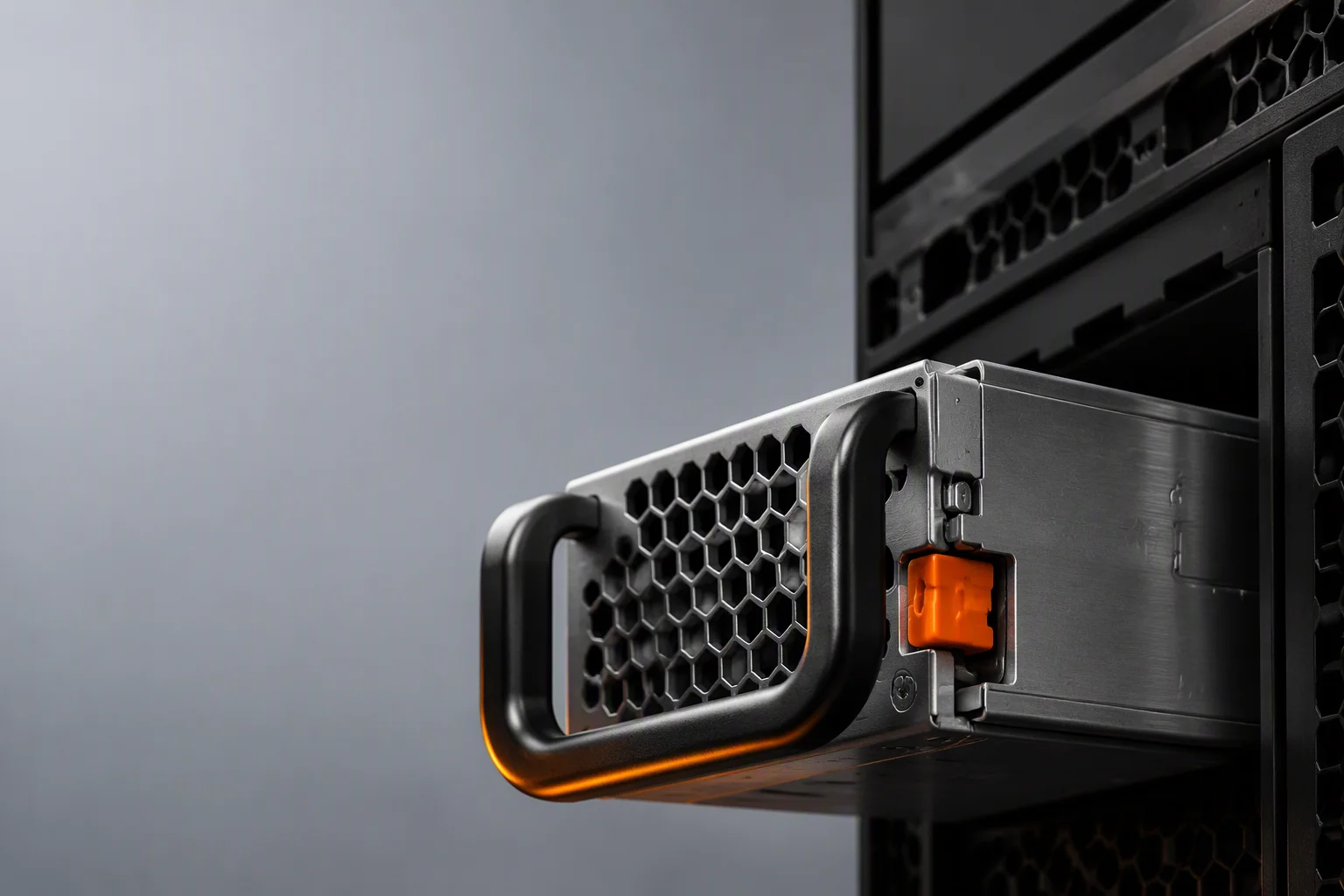
Each PSU is sealed in an anti-static bag with pearl-foam cushioning, then packed in export-grade cartons. A CRPS-185 unit weighs under 1.2 kg, so a full carton stays well within single-handler limits.
No. CRPS power supplies are ordinary cargo, not lithium batteries, so both air and sea freight move without UN38.3 documentation or DG surcharges.
Units carry a standard warranty against manufacturing defects. Every production order can include burn-in screening records and ATE test reports, and we support failure analysis with unit-level traceability for RMA cases.
Yes. PMBus 1.2 telemetry is standard — voltage, current, temperature and fan speed. We can tailor the command set, alert thresholds, ORing behavior and firmware update flow to match your BMC or shelf manager.
We check golden-finger connector tolerances, airflow direction, hold-up time and hot-swap insertion sequencing against your chassis. Before volume release we can run per-carton compatibility tests so every unit that ships has been mated with a reference backplane.
The baseline is IEC/UL 62368-1 safety with CB scheme recognition, plus CE, UKCA, FCC Part 15 Subpart B, RoHS 2.0 and REACH. Regional marks — CCC, KC, BSMI, EAC, BIS — are arranged market by market; tell us your destination and we map the matrix.
550W through 2400W CRPS Titanium are in production. The 3kW–5.5kW M-CRPS segment is at development-sample stage and open for joint evaluation, and 8kW+ GPU power is on the roadmap. We label the stage explicitly on every product page.
Catalog samples are available to qualified engineering teams for evaluation; sample cost can be credited against the first volume order. Custom-platform samples are quoted per project together with any NRE.
Yes — we routinely sign mutual NDAs before exchanging chassis drawings, thermal data or joint specifications. Project files remain segregated within the assigned engineering team.

Have a Question Not Listed Here?
Send the spec — a sales engineer replies within 48 hours.
Contact TitanWatt