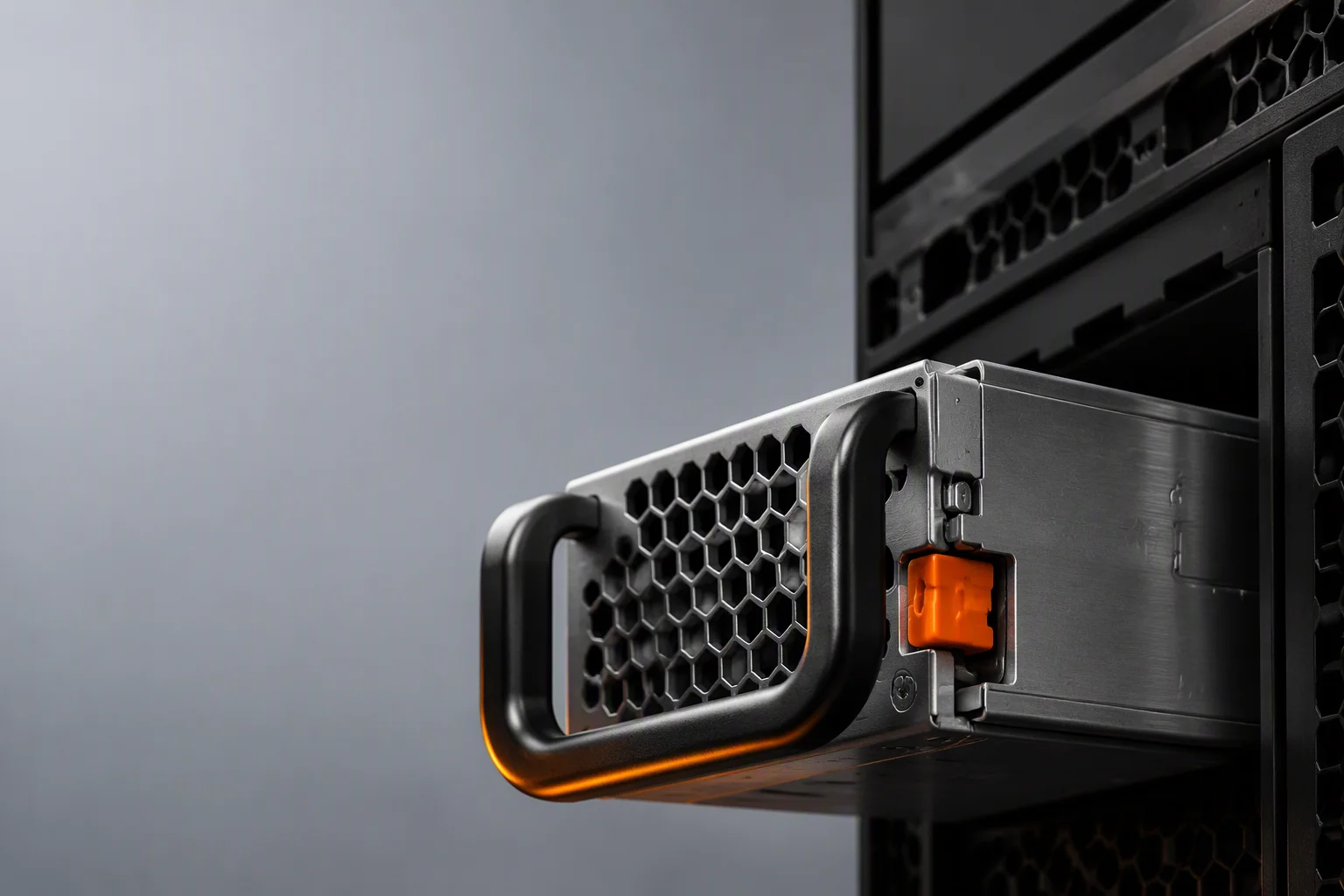
CRPS & M-CRPS Power Supply Products
TitanWatt covers the rack power chain from 550W classic CRPS modules to a 33kW power shelf concept. Every wattage segment below carries an honest status label — what is in production, what exists as development samples, and what is roadmap. We would rather tell you the truth about a wattage band than sell you a datasheet that does not exist yet.
| Segment | Form Factor / Output | Status |
|---|---|---|
| 550W / 800W / 1300W CRPS | CRPS-185, 1U, 12V main output | In production |
| 1600W / 2000W / 2400W CRPS | CRPS-185, 1U, 12V, C19 input, 75 W/in³ class | In production |
| 3000W / 3300W / 5500W M-CRPS | Modular output section, 54V / 12V configurable, ORv3 slot target | Development Samples |
| GPU server power solutions | CRPS/M-CRPS arrays with 54V distribution and PMBus telemetry | Solution — built on production parts |
| 33kW power shelf (6×5.5kW, 5+1) | ORv3-style shelf, 54V busbar | Roadmap |
The Industry Ladder, and Where We Stand on It
Solid = in volume production · Outlined = development samples for joint evaluation · Road = roadmap, defined together with lead customers.
The rungs are not arbitrary. Established CRPS vendors step 550 → 800 → 1300 → 1600 → 2000 → 2400W inside the same 73.5×40×185mm envelope, then the industry jumps to 3kW/5.5kW modular units for ORv3 shelves — Delta's ORv3 line pairs 3kW and 5.5kW PSUs with 18kW and 33kW systems. Our ladder follows the same physics: first master the envelope, then modularize, then scale the shelf.
Five Series, One Power Chain
Classic CRPS Titanium
The 1U/2U workhorse band. 96% peak efficiency at 50% load, 73.5×40×185mm envelope, CRPS-185 golden-finger connector, PMBus 1.2 on smart units.
Series detail →High-Density CRPS Titanium
The top of the in-production ladder. C19 input at 200Vac, up to 75 W/in³ class density, active current sharing for N+1 arrays feeding GPU and storage nodes.
Series detail →M-CRPS 3000W–5500W
Modular power + output sections on the OCP M-CRPS path, targeting ORv3 slot compatibility at 54V. All specifications published as target specs for joint development.
Development status →GPU Server Power
An 8-GPU HGX node pulls 10kW+ of system load, and a B200 draws 1000W apiece. How we combine CRPS arrays, 54V busbars and telemetry per node type.
Solution guide →Power Shelf 33kW
Six 5.5kW modules, 5+1 redundancy, one 54V busbar: 33kW per shelf. Where the industry is heading and how our M-CRPS program feeds into it.
Architecture view →OEM / ODM Projects
Connector layouts, harnesses, bezels and PMBus command sets adapted to your platform from pilot volumes — with FAE support from spec review to批量 production.
Start a project →Selecting a Supply in Four Steps
Sum worst-case CPU, GPU, disk and fan draw, then add 20–30% headroom. An 8-GPU H100 node alone is 5.6kW of bare GPU load before the rest of the board spins up.
12V stays right for 1U/2U servers and storage. 54V wins when current gets large: four times lower current means roughly sixteen times lower resistive loss in the distribution path.
N+1 with active current sharing covers most racks; N+N dual power paths suit storage controllers. For standby-heavy fleets ask about cold redundancy and power throttling behavior.
Dumb-but-reliable units keep BOM cost down; PMBus 1.2 telemetry over I²C gives you voltage, current, temperature and fan speed per module for fleet-level power management.
Customization Scope
As a manufacturer with SMT+DIP lines, ATE test and a burn-in aging room in-house, we can move beyond catalog parts. Customizable dimensions of a project typically include:
Mechanical & interface
Bezel and handle styling, connector and harness definitions, airflow direction (front-to-back or back-to-front) matched to your chassis — on the standard CRPS-185 envelope or a custom footprint.
Electrical & firmware
Output rail configuration, protection thresholds (OVP/UVP/OCP/OTP), fan curves, and a tailored PMBus command set so the supply reports exactly the telemetry your BMC expects.
Standard products start at 100–500 pcs per order; samples ship in 2–4 weeks, volume production in 6–10 weeks. ODM projects are scoped individually.

Not Sure Which Segment Fits?
Send us your power budget and chassis constraints — we reply within 48 hours with a segment recommendation and datasheet summary.