CRPS vs M-CRPS Explained
They share a 1U footprint and much of their vocabulary, yet they answer different questions. If your platform is choosing between them, the decision hinges on power level, output architecture and how open your supply chain needs to be.
What "CRPS" Actually Means
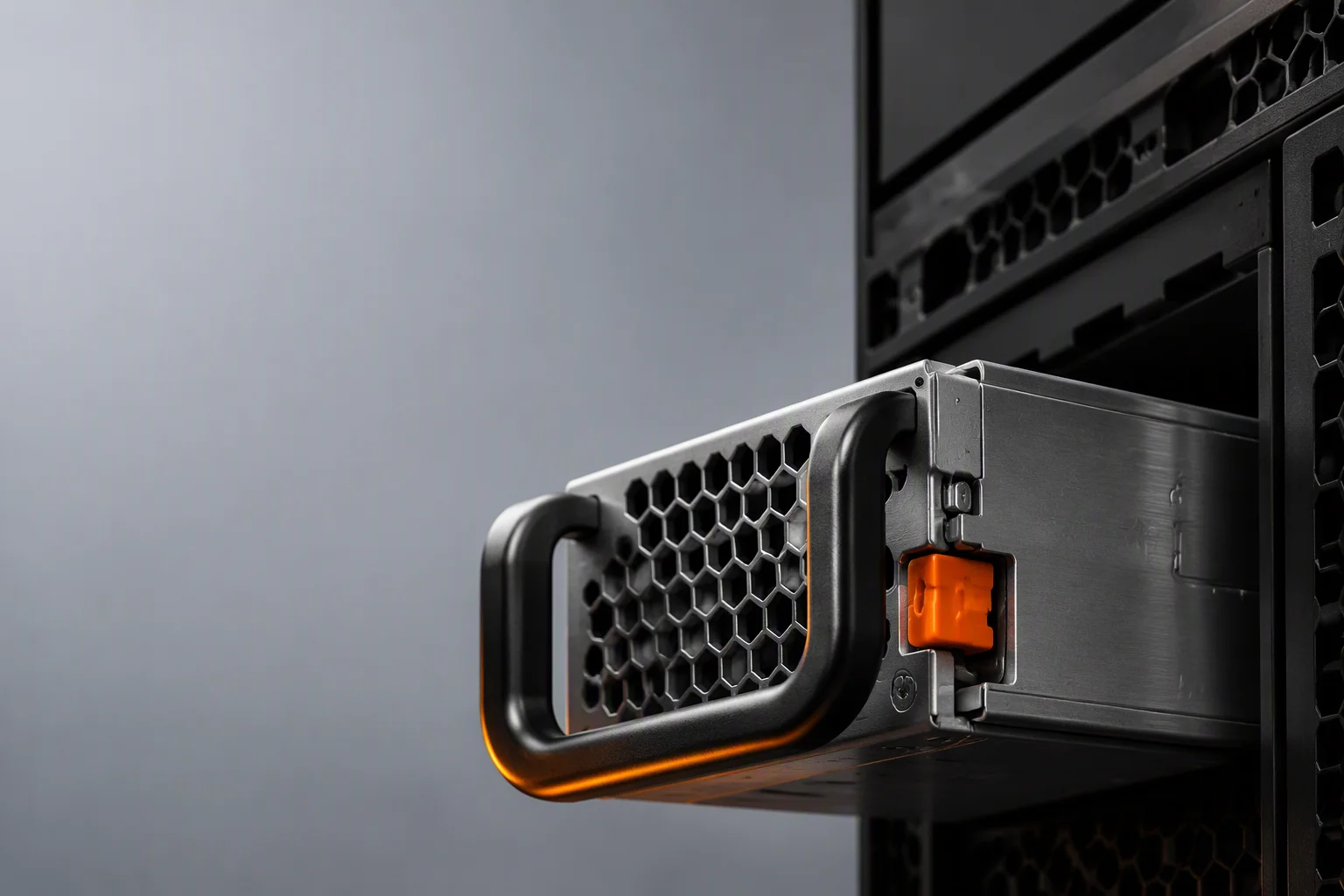
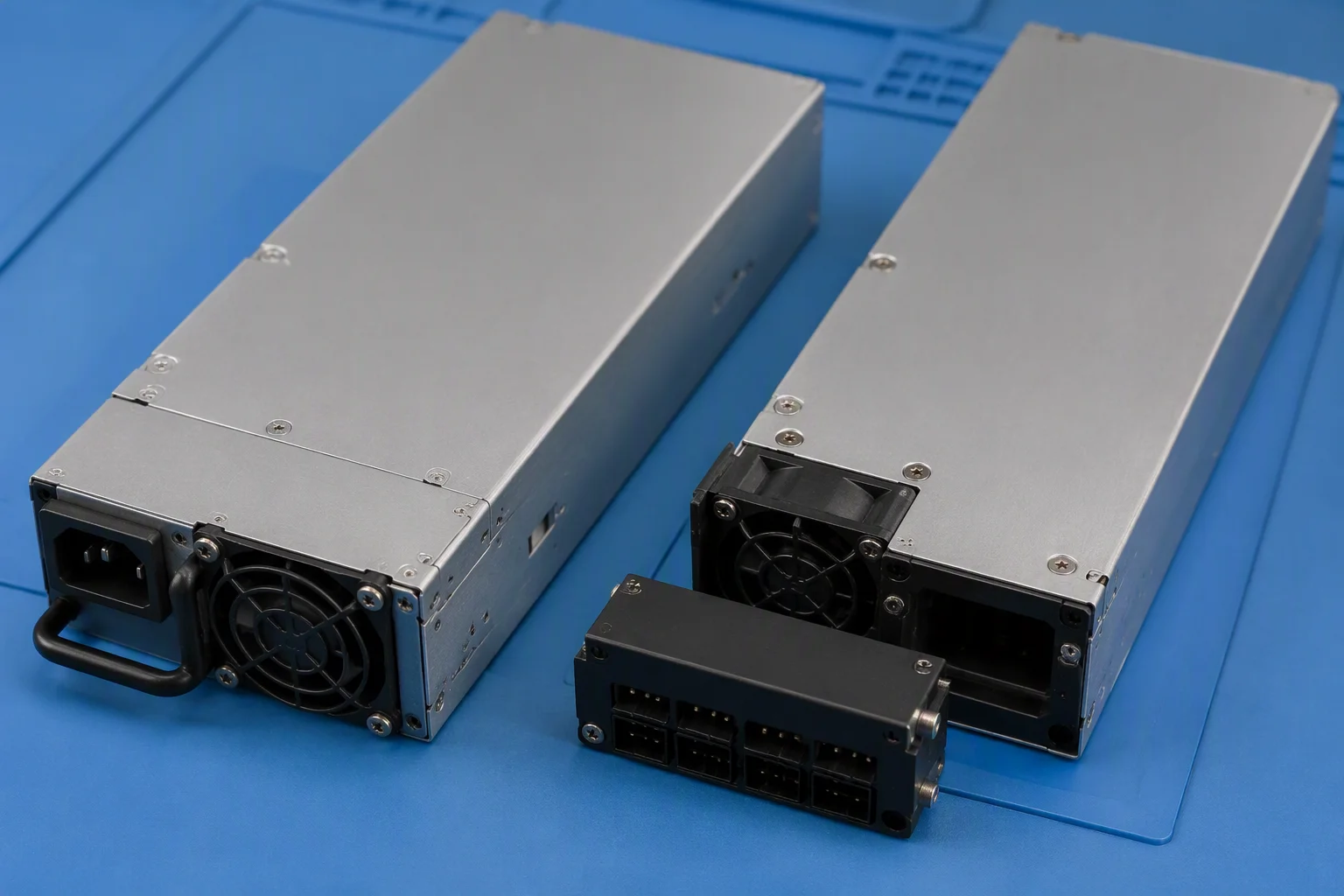
CRPS — Common Redundant Power Supply — is a form factor that originated in Intel's server specifications and became a de facto industry standard through sheer ecosystem adoption. The classic CRPS-185 unit measures 73.5 × 40 × 185 mm: 1U tall, 40mm wide, 185mm deep, with a fixed golden-finger connector at the rear that mates with the chassis backplane. A shorter CRPS-130 variant (130mm deep) exists for compact chassis. Because the envelope and connector are standardized, a CRPS PSU from any qualified vendor drops into any CRPS chassis — which is exactly why the format dominates enterprise servers, storage arrays and switches.
The classic CRPS architecture delivers a single 12V main output (plus a 5V standby rail), front-to-back or back-to-front airflow, hot-plug operation, and — at the quality end — 80 PLUS Titanium efficiency, PMBus telemetry and five-way protection (OVP, UVP, OCP, OTP, fan fault). The commercially healthy range runs from 550W to 2400W; specialist vendors have stretched the format to 3200W, but beyond roughly 2.5kW the fixed envelope starts fighting physics: less volume for magnetics and heat sinking, and a single 40mm fan approaching its acoustic limit.
What "M-CRPS" Changes
M-CRPS — Modular CRPS — comes out of the Open Compute Project's evolution of the same idea. It keeps a compatible starting envelope but splits the supply into functional blocks: a power stage and a detachable, configurable output section. That single change rewrites the scaling math. The output block can be configured for 12V, 48V or 54V architectures, connectors can change per platform, and the extra volume available in the modular scheme supports far higher per-unit power — the segment now centers on 3kW to 5.5kW units designed around ORv3 (Open Rack v3) slot definitions.
The reason 54V matters is copper. At the same power, raising distribution voltage from 12V to 54V cuts current by a factor of four, and since conduction loss scales with the square of current, busbar and cable losses fall by roughly 16×. At 3–5.5kW per slot and multi-slot shelves, that difference is the difference between a workable rack and a melted one. M-CRPS is therefore less a "new CRPS" than the power-supply half of the 54V data center architecture.
The Comparison Table
| Dimension | CRPS (classic) | M-CRPS (modular) |
|---|---|---|
| Spec origin | Intel spec, de facto standard | OCP open-spec evolution |
| Envelope | 73.5×40×185 mm (or 130mm) | Compatible start, modular output section |
| Power range | 550W–2400W mainstream | 3kW–5.5kW (ORv3 slots) |
| Output | Fixed 12V main + 5VSB | 12V / 48V / 54V configurable |
| Connector | Fixed golden finger | Split power + output blocks |
| Typical use | 1U/2U servers, storage, switches | AI/GPU servers, ORv3 racks, hyperscale |
How the Industry Got Here
The wattage ladder tells the story. Vendors scaled classic CRPS step by step — 550W, 800W, 1300W, 1600W, 2000W, 2400W — squeezing more power out of the same envelope through better topology (LLC resonant conversion, synchronous rectification) and denser magnetics. Meanwhile OCP's Open Rack v3 pushed the other direction: instead of forcing more power through a fixed form factor, it scaled the system, defining power shelves that hold six hot-plug PSU slots. A 33kW shelf is six 5.5kW units in 5+1 redundancy; two shelves feed a GB200-class rack approaching 120kW. M-CRPS is the unit-level expression of that system-level thinking.
For buyers, the ecosystem consequence is real: classic CRPS gives you a deep, multi-vendor drop-in market today, while M-CRPS gives you a forward path into 54V racks where the vendor list is still short and development partnerships carry weight. Our own position reflects that: the 1600W–2400W CRPS titanium series is in production, while the M-CRPS 3000W–5500W program is at development-sample stage and open to joint specification — we label both stages explicitly.
So Which Should You Specify?
Stay with classic CRPS if your platform is a 1U/2U general server, storage array or ToR switch drawing under ~2.5kW — the drop-in ecosystem, chassis availability and pricing are unbeatable, and Titanium-class units erase the efficiency argument for moving. Move to M-CRPS if you are designing AI/GPU nodes above 8–10kW system power, building to ORv3, or planning a 54V busbar architecture where per-unit power of 3–5.5kW and modular output configuration are structural requirements, not luxuries. If you sit on the boundary — say a 10kW node choosing between a 2400W CRPS array and 3.3kW M-CRPS units — the deciding factors are usually your shelf or backplane roadmap and your vendor's stage in the M-CRPS ramp; both are fair questions to ask any supplier.
For the system-level half of this decision, see the power shelf program page for how six M-CRPS units become a 33kW building block.
Related Reading
Titanium vs Gold: the Efficiency Math Buyers Skip
92% vs 96% at 50% load — what the four points are worth per node per year.
Read →GPU Rack Power Trends: from 5kW to 120kW
Why 54V busbars and 33kW shelves exist, in three numbers.
Read →M-CRPS 3000W–5500W (Development Samples)
Our 54V-capable modular program, open for joint specification with early partners.
Explore →
Not Sure Which Format Fits?
Send the platform outline — we will recommend CRPS or M-CRPS with a spec comparison, not a sales pitch.
Ask an Engineer