GPU Rack Power Trends: from 5kW to 120kW
In roughly one hardware generation, the power budget of a single rack grew by an order of magnitude. The PSU did not get bigger — the architecture changed. Here are the numbers that forced the rewrite.
It Starts at the Chip
An NVIDIA H100 SXM module has a thermal design power of 700W. The Blackwell-generation B200 raises that to 1000W — a 43% jump between consecutive flagship generations. At the board and cable level, the 12VHPWR connector used by card-class hardware tops out at 600W per cable, which is itself a compromise that the SXM world routes around with onboard power stages. The trend line is unambiguous: power per GPU is rising faster than efficiency gains can offset, and every acceleration generation rewrites the delivery problem one level below.
Node Math: Why 8 GPUs Means 10kW+
Scale up to a standard HGX-style 8-GPU node. Eight H100s alone demand 5.6kW of GPU-side power; eight B200s push past 8kW. Add CPUs, memory pools, NVSwitches, NICs, NICs' heat and the inevitable overhead, and a fully equipped node lands at 10kW or more of system power. No single form factor carries that gracefully: the practical answer is a front end of three to four 3–5.5kW power supplies in an N+1 array, feeding board-level converters that step voltage down to each accelerator. This is exactly the load profile where 96%-efficient titanium units matter most — at 10kW continuous, the efficiency difference between tiers is hundreds of watts of heat inside an already thermally desperate chassis.
The Rack Rewrites Itself
Zoom out one more level and the discontinuity appears. A traditional enterprise rack drew 5–10kW — the number that shaped a generation of PDU, breaker and cabling standards. AI racks now measure 40–120kW. The GB200 NVL72-class configuration, with 72 tightly coupled accelerators liquid-cooled in one enclosure, sits at the top of that band around 120kW. You cannot feed 120kW through the assumptions of a 7kW rack: branch circuits, busway capacity, and above all voltage-drop physics all fail at once.
That physics is why 54V won. Doubling from a 12V distribution bus to 54V cuts current by roughly 4× for the same power, and because conduction loss scales with the square of current, line losses fall by about 16×. At 120kW the difference between 12V and 54V distribution is not an optimization — it is the boundary between a working rack and copper that cannot fit in the floor plan. The 54V busbar running down the rack spine is now the defining feature of AI power architecture.
Where Power Supplies Live in This Picture
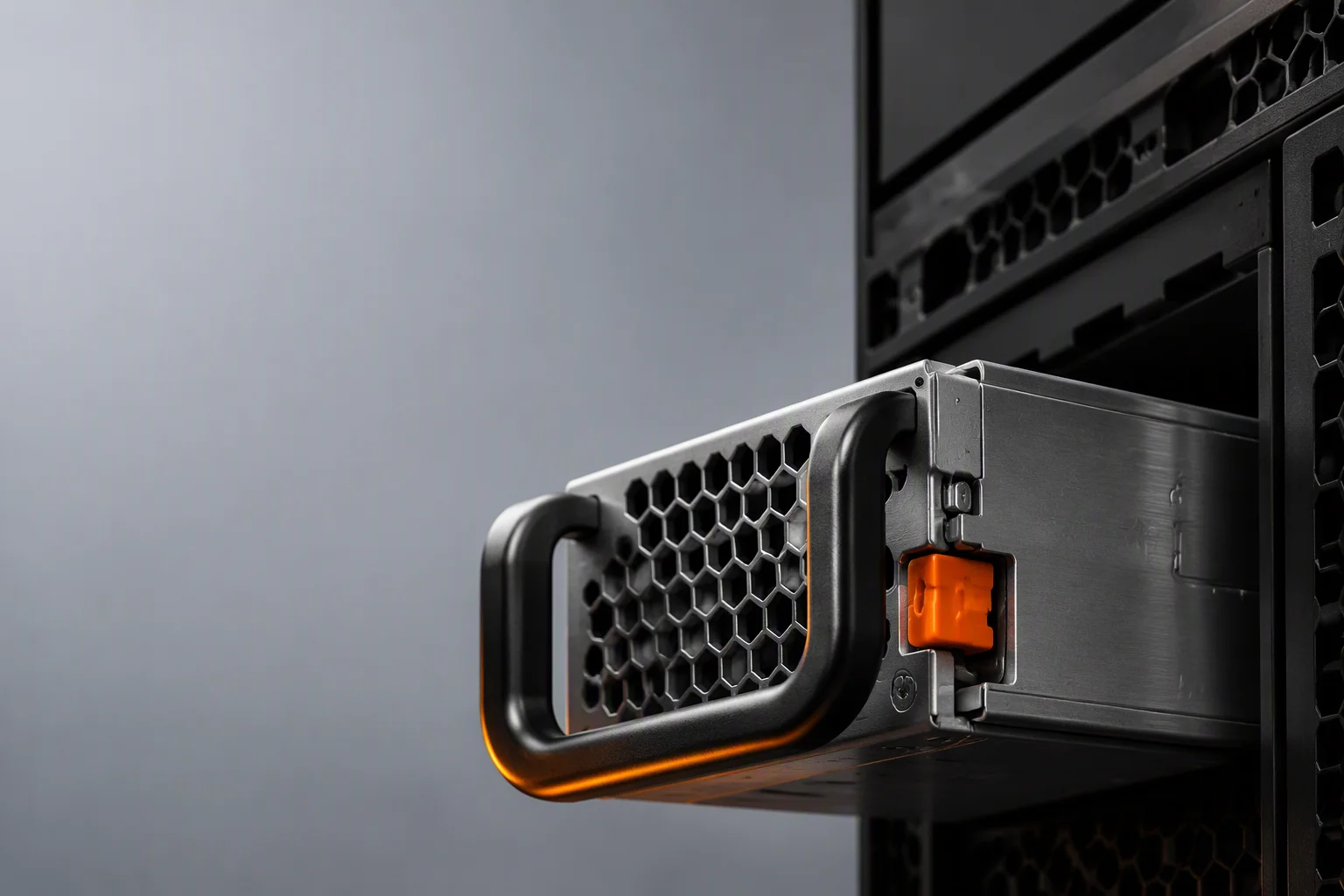
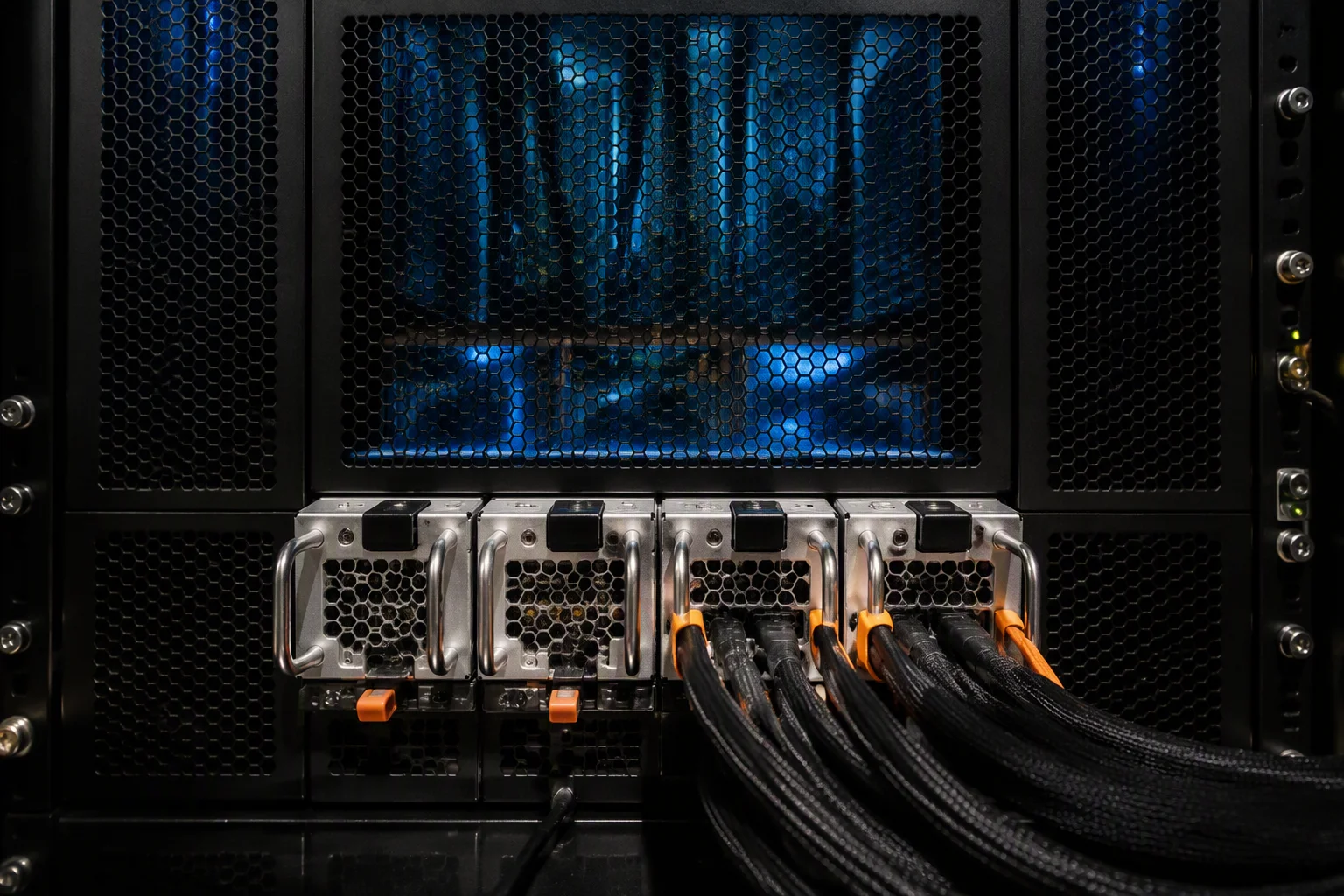
The unit that feeds the busbar is the power shelf: a hot-plug frame of six slots holding modular M-CRPS-class supplies. The arithmetic is neat — a 33kW shelf is six 5.5kW units in 5+1 redundancy, meaning the rack runs at full load even with one unit extracted. A 120kW GB200-class rack carries roughly four 33kW shelves (12–13kW of shelf per bus segment being the practical sweet spot for breaker and busbar coordination). Vendor lineups mirror this: the industry's leading power vendors publish ORv3 shelves at 18kW and 33kW built from 3kW and 5.5kW PSU units, and the open-spec momentum means hyperscalers increasingly buy shelves and units as separately sourced layers.
What This Means for the Power Supply Chain
Three consequences follow for anyone sourcing power for AI platforms. First, the PSU moved up the BOM in priority: when a single unplanned hour can cost more than an entire rack of power supplies, an N+1 array with proven hot-swap behavior and PMBus telemetry for predictive replacement is no longer a line-item decision. Second, the qualified-vendor list for 3–5.5kW M-CRPS is still short, because the segment is young — which is why hyperscale and ODMA buyers are signing joint-development agreements with specialist manufacturers rather than waiting for catalog parts. Third, the roadmap pressure continues: 8kW and 12kW per-unit GPU supplies are on the industry roadmap for the next rack generation, and every step upward reopens the topology, cooling and connector questions that 5.5kW just settled.
For buyers mapping this onto their own platform: our GPU power solutions page lays out supply combinations by node class, and the AI data center industry page walks the full rack-level chain from utility feed to accelerator. Our 550W–2400W CRPS series is in production for node front ends today; the 3–5.5kW M-CRPS program is at development-sample stage and accepting joint-specification partners — stages stated plainly, because in this segment the roadmap maturity of your PSU vendor is itself a risk item.
Related Reading
CRPS vs M-CRPS Explained
The fixed-envelope format versus the modular 54V format that power shelves are built from.
Read →Titanium vs Gold: the Efficiency Math Buyers Skip
430W per 10kW node per hour — the cost hidden in four efficiency points.
Read →Power Shelf Program
From six 5.5kW units to a 33kW shelf — our system-level direction and partner model.
Explore →
Building a GPU Node or Rack?
Share your node power budget — we will map the CRPS and M-CRPS combination that fits it.
Start the Conversation