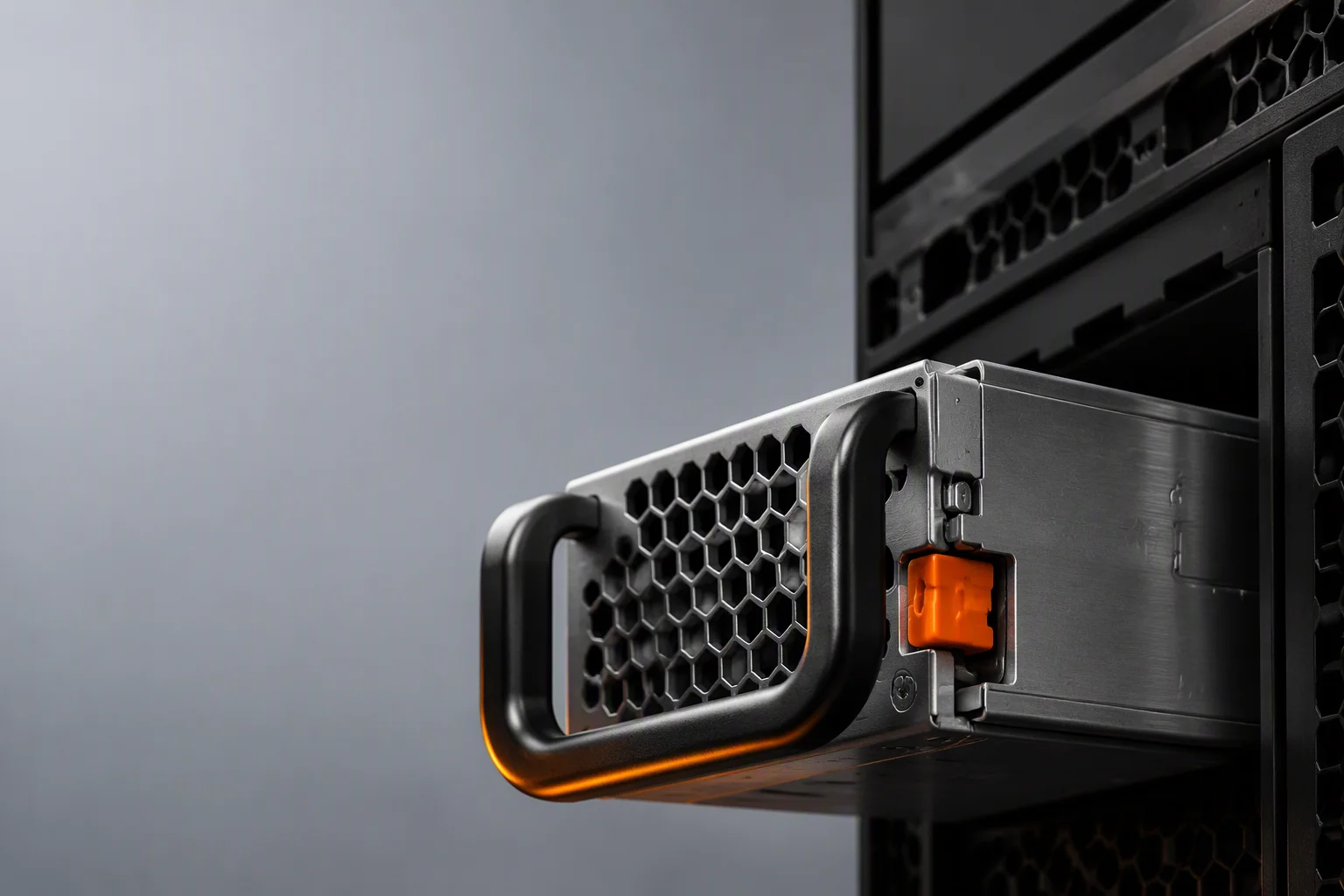
Titanium vs Gold: the Efficiency Math Buyers Skip
"92% or 96% — it's only four points." That framing hides where the four points land: at the exact load where servers spend their lives. Here is the arithmetic, run honestly, with assumptions stated.
The 80 PLUS Ladder, in One Table
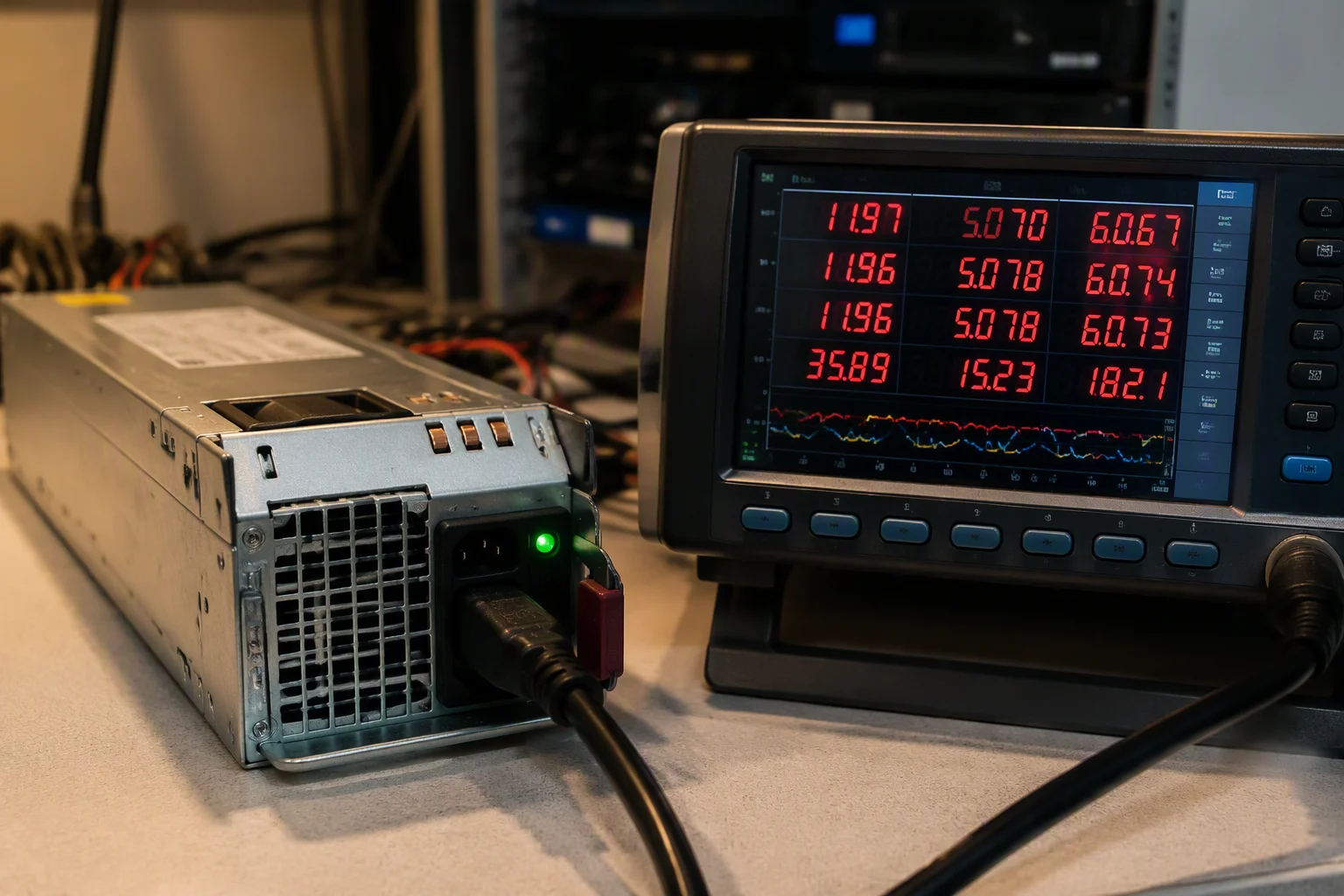
80 PLUS certifies power supplies at defined load points against defined efficiency floors. For data center redundant internal supplies, the relevant schedule is the 230V internal redundant rating, which tests 10%, 50% and 100% load. The tier floors look like this:
| Rating | 10% load | 50% load | 100% load |
|---|---|---|---|
| Gold | 82% | 92% | 89% |
| Platinum | 90% | 94% | 91% |
| Titanium | 90% | 96% | 91% |
Two things matter in this table beyond the headline 96%. First, Titanium is the only tier with a hard 10% requirement (90%), which is precisely where lightly loaded redundant arrays idle. Second, the Gold-tier 50% point of 92% is where the biggest cost gap hides — not at full load.
Why the 50% Point Dominates Real Life
Server power supplies are sized for peak and run below it. A node specified with a 2400W PSU pair at N+1 spends most of its life drawing a fraction of that, which pushes each PSU toward its 30–60% efficiency sweet spot — or away from it. That is why 80 PLUS publishes the 50% point at all, and why procurement teams that compare nameplate efficiency instead of mid-load efficiency systematically underprice the difference.
At 50% load, moving from a Gold unit (92%) to a Titanium unit (96%) cuts the loss inside the PSU by two thirds relative to the delivered work? Not quite — let's do the direct numbers. Delivering 5,000W to a 10kW-class node at half load: a Gold PSU drawing to deliver 5,000W consumes 5,000 / 0.92 = 5,435W, losing 435W as heat. The Titanium unit consumes 5,000 / 0.96 = 5,208W, losing 208W. The difference is roughly 430W per 10kW of delivered load, every operating hour — wasted inside the chassis as heat that the cooling system must then remove a second time.
The Annual Electricity Estimate
Assume a fleet of nodes whose aggregated delivered power is 10kW per node, running at an average 50% PSU utilization for 24/7 operation, and assume an industrial electricity price of $0.10 per kWh (state your own tariff; this is an assumption for illustration, not a quote).
- Extra loss per node with Gold: 430W × 8,760 h = 3,767 kWh per year.
- At $0.10/kWh: about $377 per node per year in direct energy cost.
- Cooling removes that heat again at a typical PUE-linked overhead of 10–30%, adding roughly $38–$113 — call it $415–$490 all-in per node per year.
A thousand-node deployment therefore burns $400k-plus per year feeding the efficiency gap, before any carbon accounting. At hyperscale the arithmetic is starker: industry analyses commonly find that a single efficiency point across a hundred-thousand-server fleet moves annual energy spend by millions of dollars, which is why ODM-direct buyers treat 80 PLUS Titanium as a gate, not a nice-to-have.
The Cooling-Side Dividend
Every watt lost inside a PSU leaves as heat in the exhaust airstream. 430W per node of avoided loss means fans run slower or less often, thermal margins widen, and — more strategically — the freed thermal budget can be spent on higher component density rather than on moving the same heat more aggressively. This is why high-density designs converge on Titanium PSUs even before the electricity bill is tallied: in a 75 W/in³-class 2400W CRPS, the losses at 96% are small enough to hold in a single 40mm fan's acoustic envelope, whereas a Gold-class unit at the same power would push substantially more heat into the same 1U of exhaust.
Reliability compounds the story. Losses translate into internal component temperature, and component temperature is the dominant stressor behind power supply field failures. With a design target of ≥250,000 hours MTBF at 40°C (Telcordia SR-332), a cooler-running Titanium unit is not just cheaper to power — it is cheaper to not have fail. In that light, avoided failure events dominate every other line in the efficiency comparison.
When Does Titanium Pay Back?
Titanium units carry a price premium over Gold — typically low double-digit percentages at the 800W–2400W level, narrowing at volume. Run the payback with your own numbers, but the pattern is consistent:
- Always-on, mid-load fleets (enterprise servers, storage, networking): the ~$400–$490/node/year energy-plus-cooling saving clears a realistic premium within one to three years, and the units keep saving for their remaining life.
- Bursty or lightly loaded systems: even better, because the Titanium 10% floor of 90% vs Gold's 82% widens the gap further at low utilization.
- GPU-dense nodes: less about the fee, more about the thermal headroom and redundancy quality — a 96% unit in an N+1 array wastes less of your 10kW+ node budget and runs cooler in a constrained exhaust path.
- Rarely-on systems: the math weakens; if a machine idles at 5% of rated power and sleeps most nights, the tier difference is noise. Buy the cheaper tier there.
The practical takeaway: treat the tier as an operating-expense decision with a calculable payback, not a spec-sheet badge. If you want to pressure-test the math against a real fleet profile, send the load curve — we run the comparison before you commit. Our CRPS 1600W–2400W titanium series covers the high-density end, and the full engineering background lives on the 80 PLUS Titanium efficiency capability page.
Related Reading
CRPS vs M-CRPS Explained
Same 73.5×40×185 mm envelope, two eras of output architecture — where classic CRPS ends and modular M-CRPS takes over.
Read →GPU Rack Power Trends: from 5kW to 120kW
H100 at 700W, B200 at 1000W, racks at 40–120kW: how AI load reshaped PSU selection.
Read →80 PLUS Titanium Efficiency Engineering
The tier thresholds, topology choices and test data behind our 96% peak-efficiency CRPS units.
Explore →
Run the Math on Your Fleet
Send your load profile — we will return the titanium-vs-gold comparison with your tariff and duty cycle.
Contact TitanWatt